I. Pre-Google: the wild west of search
A personal chapter from an internet that had no rules yet.
When someone says today that SEO is “dead,” I always find myself thinking back to where it all started — not for the industry, but for me personally.
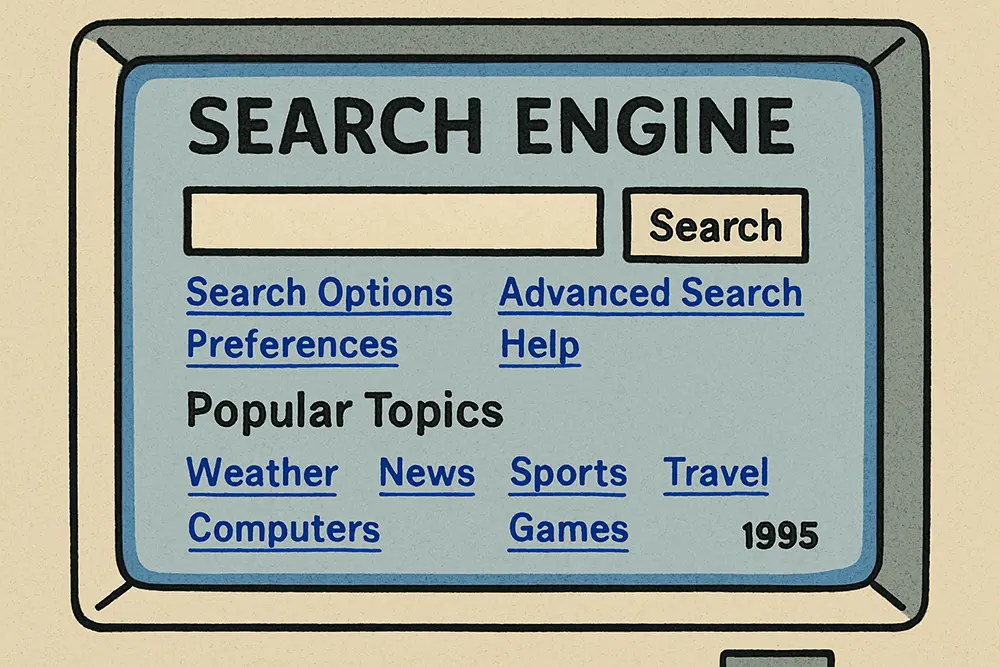
I was already on the internet in 1995, at a time when websites were mostly made of HTML tables, blinking GIFs and a kind of charming chaos. It was an internet that didn’t yet know what it wanted to be — and that’s exactly what made it fascinating.
My own little corner of it? A website with walkthroughs and cheat codes for video games.
Nothing remarkable by today’s standards, but in 1995 it felt like building a digital library accessible to the whole world. I still remember it perfectly: the first time I had 50 visitors in a single day. Fifty!
In a world where almost no one was online, that felt like a full auditorium. Fifty people reading your text, finding your page, needing your content.
And that was the very first form of what would later become Search Engine Optimization (SEO): making sure people could find you.
The search engines of the early days
But… there was no Google. There was:
- Altavista
- Lycos
- HotBot
- Webcrawler
- Excite
- Yahoo (via directories)
These weren’t search engines as we know them today. They indexed sporadically, incompletely and often unpredictably. Ranking wasn’t a matter of algorithms — it was a matter of a few simple actions.
This was the practice of pre-Google SEO:
- Registering your site via a form with each engine individually.
- Filling in your meta keywords (the tag that literally determined ranking).
- Getting yourself placed in the right Yahoo Directory by a human editor.
- Building webrings with other sites.
- Giving pages hundreds of internal links, because that seemed to help.
The first form of abuse (Black Hat 0.1)
And of course, where technology goes, abuse quickly follows. Once it became known that the Meta Keyword Tag influenced rankings, webmasters started stuffing it with hundreds — often irrelevant — keywords. This was the earliest version of what we’d later call keyword stuffing — the first steps of Black Hat SEO. The engines were still too naive to filter it out. Findability was still quantity over quality.
The unique role of Yahoo
Yahoo was an outlier — and an essential chapter in the history of findability. While Altavista and Lycos tried to machine-index the entire web (and failed), Yahoo was essentially a human-curated directory. Your SEO strategy here was literally: submit your site and wait for a human editor to decide which category you belonged in. A ranking here was a seal of approval — and with it, trust — a concept that would later become crucial.
This was pre-SEO, but the core principles were already there. It was about:
- Findability
- Relevance
- Access to information
- Connecting content to intent
The realisation that “people can find me here” is exactly the same drive that would later define modern SEO.
The internet was small, but the impact was large. There were no algorithms to fool — just simple technique. And yet… that feeling of “someone found my page” was exactly the same as when businesses today watch their organic traffic grow. SEO has always started with behaviour, not algorithms. That’s the thread running through every decade.
What the pre-2000 period teaches us
- Search is older than Google.
- The need to be found is constant.
- People want answers, always.
- Rankings were already a form of trust back then (human or technical).
- The foundations of manipulation (Black Hat) and quality (White Hat) are as old as the search engine itself.
- SEO has never been a purely technical discipline. It is a human phenomenon that evolves alongside technology.
II. Laying the foundation: PageRank and the first SEO war (2000–2010)
How one idea redrew the entire evolution of search engines.
Around the year 2000 came the defining break that would redefine the entire industry: Google.
Not just because Google delivered better results — other engines sometimes did too, depending on the topic. Google won because it had invented a completely new way of understanding the web. Where Altavista and Lycos still focused mainly on what was written on a page, Google looked at how the web was connected to itself.
That idea was called PageRank.
2.1. PageRank: the algorithm that turned the web into a reputation system

PageRank was radically simple and brilliant:
“A link is a vote. And not all votes are equal.”
In other words:
- A page linked to by many other pages = important.
- A link from a relevant, well-regarded site = more valuable.
- A link from a spammy site = almost irrelevant.
For the first time, a search engine wasn’t relying purely on text, but on trust, reputation and context. An early precursor to E-E-A-T, you could say.
Crucial here was the Anchor Text of that link. The text used to link (for example, ‘best SEO specialist’) acted as a powerful keyword signal for the page being linked to. This made exact-match keyword anchoring the go-to tactic of early SEO.
This PageRank score was so important that Google launched the infamous Toolbar PageRank: a green bar in the browser showing a page’s “strength.” Webmasters became obsessed with their PageRank score (from 0 to 10), which only intensified the hunt for links.
PageRank made Google instantly different:
- You could no longer write yourself to the top via meta keywords.
- You had to be recognised by the rest of the web.
- Findability became a reflection of authority.
Google introduced the first real quality leap in search.
2.2. White Hat in the making: on-page and link building as a new science
Between 2000 and around 2005, SEO emerged as a discipline. The fundamentals of that era:
🔍 On-page optimisation:
For the first time, “SEO” came with a checklist: proper title tags, clear H1s, clean URL structures, alt tags and meta descriptions (no longer ranking signals, but click-through drivers). Websites needed to be optimised so search engines could understand them better.
🔗 Link building as a superpower:
PageRank put link building on the map. And at the time, almost everything worked: link exchanges, start pages, directories, footer links, blogrolls and mass link campaigns. Sometimes creative, sometimes manipulative — but it worked.
⚙️ Technical foundations became important:
Google struggled with Flash, JavaScript, dynamic URLs and poorly structured sites. SEO became partly a technical discipline: making sure Google could crawl.
📈 The internet grew — and competition emerged. Everyone started optimising and the battle for the SERPs got serious. This was the period when businesses began to realise: “We need someone who understands this.” SEO became a profession.
2.3. The first dark side: Black Hat 1.0
PageRank could be manipulated — and so it was.
What was popular back then to boost PageRank:
- Link farms and automated link spam.
- Hidden text and cloaking (showing different content to Google than to users).
- Doorway pages (pages that existed purely to redirect).
- Paid directory packages stuffed with keyword-rich links.
And… it worked. Google could detect it, but not consistently. Everyone was playing catch-up: Google tried to clean things up, spammers found new ways around it. That battle defined SEO for years.
2.4. Search went mainstream — and with it, essential
Between 2003 and 2010, the web transformed from a hobbyist space into a mainstream medium.
- Businesses went online, e-commerce exploded, information became massively accessible.
- The web grew bigger than anyone could imagine.
Search engines became the gateway to the internet, and SEO became the profession that determined who was visible at that gateway. This decade formed the foundations of what SEO still is today: the technical base, the focus on authority, the idea of relevant links, on-page structure, a growing awareness that algorithms get smarter — and the need to distinguish quality from manipulation.
And above all: SEO became a strategic advantage. Businesses that understood early how important ranking was grew disproportionately fast.
2.5. What to remember from 2000–2010
- Google won by integrating authority into search results via PageRank.
- Link building (and Anchor Text) became the core of every strategy.
- SEO became a profession, no longer a technical hobby.
- It was the first era of mass manipulation — and of the first major quality waves.
- Good SEO required structure and content for the first time.
- And perhaps most importantly: Google began evolving faster than SEO specialists could keep up — a pattern that has continued every decade since.
III. The great clean-up: Panda, Penguin and the rise of quality (2010–2015)
How Google shifted power to the user and SEO grew up.
Around 2010, Google began the biggest restructuring of the web since the introduction of PageRank.
For ten years, small webmasters, niche blogs, affiliate sites and link networks had dominated the landscape. SEO had long been a meritocracy: whoever worked hardest, wrote the most content or knew the cleverest technical tricks could win. But the web had changed. More content, more spam, more commerce — and the quality of search results was starting to suffer.
Google drew a clear line in the sand: “The internet must provide value to users, not to publishers.”
That led to a series of updates that shook the industry to its core: Panda, Penguin, the mobile revolution and Hummingbird. This period wasn’t an evolution — it was a purge.
3.1. Panda (2011): the end of thin, lazy and meaningless content
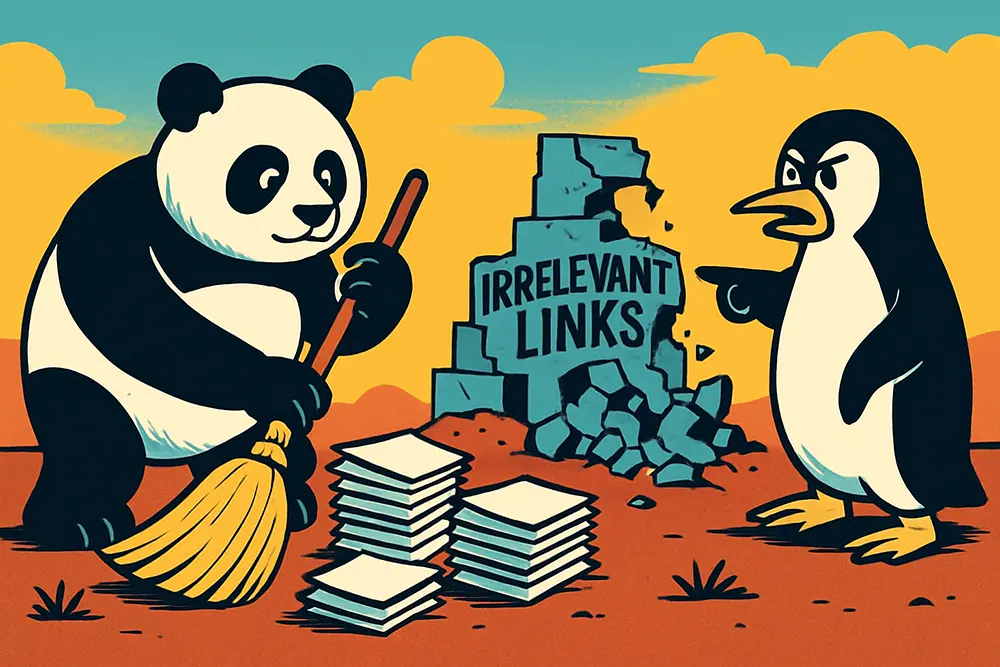
Panda was a turning point. For the first time, Google wasn’t just fighting technical manipulation — it was fighting content mediocrity.
Panda targeted:
- content farms
- thin content
- scraper sites
- pages heavy on ads and light on value
- domains with large volumes of weak content
The key changes:
- Quality over quantity: The era of “200 words and three keywords” was over. Sites with less but more valuable content finally got priority.
- Unique value became mandatory: Copied text, generic paragraphs and quickly generated content lost their visibility.
- Site-wide impact: A few weak sections could drag down an entire domain.
Panda made one thing clear: “SEO starts with content that adds something.”
3.2. Penguin (2012): the anti-spam war against unnatural links
Where Panda cleaned up content, Penguin tackled link manipulation. For ten years, the web had been riddled with link exchanges, link farms, paid backlinks and exact-match anchor text spamming. Penguin turned that world upside down.
The key changes:
- Irrelevant links lost their value — or became harmful: Links from spammy or unrelated domains carried risks.
- Exact-match anchor text became a red flag: “Buy cheap flights” × 100 was seen as manipulation.
- Link building became a reputation discipline: Not quantity, but quality and context.
Penguin matured link building: “Your authority has to be earned, not bought.”
3.3. The mobile explosion: UX as a ranking factor
While the industry was still recovering from Panda and Penguin, something even more fundamental happened: the internet went mobile.
Google responded by:
- Rewarding mobile-friendly sites: Not mobile-friendly? No top results.
- Using PageSpeed and performance as a signal: Load time became part of quality, and PageSpeed became the precursor to later metrics like Core Web Vitals.
- Letting local SEO explode: Searches like “restaurant” or “dentist” were automatically interpreted as local.
The introduction of mobile was the first step toward a broader reality: “SEO is no longer just text and links. SEO is user experience.”
3.4. Hummingbird (2013): the birth of semantic and intent-driven search
Hummingbird was a quiet revolution. It wasn’t a penalty update — it was a rewrite of how Google understood language.
For the first time, Google could:
- interpret search queries based on meaning
- automatically connect synonyms
- look for answers to concepts, not just keywords
- use context to deliver better results
The result?
- SEO became less keyword-driven: Writing keyword variations for SEO lost its purpose.
- Language became more natural: Google started to resemble people: understanding intent, not just matching words.
- Content had to become coherent and in-depth: Separate pages per keyword variant lost out to one coherent, in-depth treatment of the topic.
Hummingbird ushered in the modern, semantic Google — the precursor to RankBrain and BERT.
3.5. What makes this period unique: quality as the new standard
The 2010–2015 period brought five fundamental shifts:
- Relevance > volume
- Real value > SEO filler text
- Natural link profile > link manipulation
- UX > technical perfection
- Intent > keywords
SEO grew up. It became marketing. But that had a downside.
3.6. The systemic shift: from meritocracy to large domains
Until around 2010, the SEO landscape was surprisingly democratic. A small, hardworking webmaster could beat a multinational if their content was better.
After Panda, Penguin and Mobile-Friendliness, that changed.
- Large players were better positioned to meet the new quality bar. Reasons: editorial teams, UX experts, technical budgets, consistent content standards and strong natural link profiles. They had economies of scale that small sites simply couldn’t match.
- Small players lost their relative strength. Not because their content was worse — often the opposite. But because the rules changed: domain authority became more important, reputation carried more weight and technical requirements increased.
The meritocracy of the early SEO years gave way to a professional industry. SEO became less: “Whoever works hardest, wins,” and more: “Whoever has the strongest infrastructure, reputation and content quality, wins.”
3.7. The essence of 2010–2015
This segment marks the transition from the wild west to a mature web. Key lessons from this period:
- The web was cleaned up.
- Google made a radical choice for the user.
- Content became a quality discipline.
- Links became a question of reputation.
- UX became a ranking factor.
- Intent replaced keywords.
- Small players lost ground to larger domains.
This set the stage for a new era: one of expertise, trustworthiness, topical authority and AI-driven interpretation.
IV. The authority era: E-A-T, SERP fragmentation and the rise of machine learning (2015–2020)
How Google learned to measure trust and redrew the playing field.
After Panda, Penguin and the mobile revolution, most of the mess had been cleared from the web. But Google was still facing another problem: content trustworthiness.
Technically solid sites — fast, mobile-friendly, neatly structured — could still rank prominently while the content was objectively incorrect, amateurish or even harmful. This became especially visible in “YMYL” topics (Your Money or Your Life): health, psychology, law, finance.
The question Google now faced was fundamental: “How do we ensure users don’t just find something — but the right thing?” This led to the most impactful shift of the decade: SEO became a trust discipline.
4.1. The rise of E-A-T: expertise, authority and trustworthiness as prerequisites
In 2015–2016, Google formally introduced quality criteria that had existed internally for years: E-A-T (later E-E-A-T with “Experience” as an extra layer). The source was the Search Quality Rater Guidelines — the handbook used by human evaluators to assess search results.
It covers: who the author is, what their expertise is, what the domain’s reputation is, and whether the content is objectively accurate.
E-A-T was not an algorithm and not a ranking factor, but the quality framework Google uses to evaluate its own systems — rater judgements do not directly steer rankings.
The impact was enormous:
- Expertise became mandatory: “Author unknown” or “written by content creators without relevant background” became problematic — especially in YMYL.
- Authority became domain-wide: Not just the page had to be good: the domain had to be credible within the topic area.
- Trustworthiness became a signal: Things like contact details, transparency, references and sources suddenly started to visibly count in how Google assesses quality.
- Topical Authority became the new SEO paradigm: No longer optimising individual pages, but owning topics. Google wanted to recognise: “This domain is the logical source for this subject.”
This transformed SEO from a collection of tactics into a knowledge strategy.
4.2. The SERP revolution: from 10 blue links to an information ecosystem
Between 2015 and 2020, the search results page changed dramatically. Google became less a “list of websites” and more a direct information interface.
Key changes:

- Featured Snippets (position 0): One direct answer at the top of the page that could neutralise clicks. This forced SEOs to structure content with clear, well-defined paragraphs.
- People Also Ask (PAA): A window into users’ question hierarchies; Google revealed how search intents were interconnected.
- Knowledge panels & Knowledge Graph: Google used data from the Knowledge Graph to present facts, businesses, people and concepts independently and visually.
- The SERP is no longer a ranking list — it's a battleground: You were competing with dozens of dynamic elements. This era taught us: “You’re not fighting for clicks — you’re fighting for presence.”
4.3. RankBrain and BERT: the arrival of machine learning in search
In 2015, Google introduced RankBrain, a machine learning component that helped interpret unknown or complex search queries.
RankBrain was the first step toward contextual interpretation and AI-driven intent. Later, with updates like BERT in 2019, this capability grew exponentially: Google could now understand nuance and contextual meaning in sentences at a fundamentally deeper level.
SEO became less binary, and much more: “Can you deliver the best, most complete answer?”
4.4. The disappearance of keyword data and the birth of topic clusters
From late 2011, keyword data gradually disappeared from Google Analytics under the label not provided; within a few years there was almost nothing left to measure.
- SEO could no longer be purely keyword-driven: Exact terms were no longer measurable.
- Topic clusters and content hubs emerged: The ideal site consisted of a comprehensive main article (“pillar”) and dozens of supporting pages. Topical Authority became the new standard.
4.5. The consolidation of power: strong domains gained ground
As in the previous decade, this period again reinforced the role of brands, institutions, editorial teams and organisations with demonstrable reputations. E-A-T favoured transparency, trustworthiness, expertise and authority.
Domains that could demonstrate this gained a structural advantage. For smaller players, SEO became harder again — but the bar had simply been raised higher.
4.6. The algorithmic buffer zone: why large domains are less vulnerable
The introduction of E-A-T had an unintended side effect: large domains gained a structural buffer zone. They weren’t just favoured — they were also protected, even when their content grew outdated or their UX slipped.
This is not a conspiracy; it stems from how Google assesses risk:
- Domain history = trust over time. A 20-year-old financial institution has a built-in “safety cushion.”
- Backlinks and brand reputation are cumulative. Historical authority persists, even when recent content is mediocre.
- E-A-T favours recognition. When in doubt, Google chooses the most trusted alternative.
The irony: SEO has become “fairer” in terms of quality, but less fair in terms of opportunity. The baseline for entry has risen significantly.
4.7. What to remember from 2015–2020
This period made SEO mature and strategic:
- E-A-T became the quality standard (Expertise + Authority + Trustworthiness + Experience).
- The SERP became a landscape of visibility touchpoints.
- AI began interpreting search intent (RankBrain, BERT).
- Topical Authority replaced keyword optimisation.
- The Algorithmic Buffer Zone emerged, requiring sustained long-term investment.
This era was the beginning of modern SEO thinking: search engines as knowledge interpreters, not keyword machines.
V. The Final Era: Generative AI, SGE and the future of findability (2020 – present)
How search engines evolved from indexing to interpreting, and from interpreting to creating.
Between 2020 and today, the biggest shift in the history of SEO since the arrival of Google took place. Not because people search differently — but because technology now does what previously only human experts could: formulate answers. Where RankBrain (2015) and BERT (2019) primarily understood language, today’s Large Language Models (LLMs) go one step further: they generate language.
That has one far-reaching consequence: “The user no longer needs to click to get an answer.” And that puts the traditional role of the SERP — and with it, SEO — under pressure.
But SEO isn’t disappearing — it’s changing shape. This period is the era in which SEO became a discipline of: authority, reputation, data quality, entities, content depth, human experience and AI-readiness. SEO is no longer about ranking — it’s about being a source.
5.1. The breakthrough of generative AI: from interpreting to creating
When ChatGPT broke through widely at the end of 2022, it was immediately clear that the relationship between user and search engine would change. LLMs brought three major disruptions:
- Zero-click answers became the norm rather than the exception: Where featured snippets had previously given “direct answers,” LLMs could now provide full explanations, summaries, comparisons and recommendations. The user got the answer within the interface itself.
- The cost of content production collapsed: AI made it possible to generate blog posts, guides and long-form content in minutes. The challenge shifted from writing to standing out.
- AI began functioning as an information intermediary: SEO was no longer about “placing text” — it became about feeding information: can you supply the AI with better facts? AI doesn’t redirect traffic — it changes the route.
5.2. Google's response: Search Generative Experience (SGE)
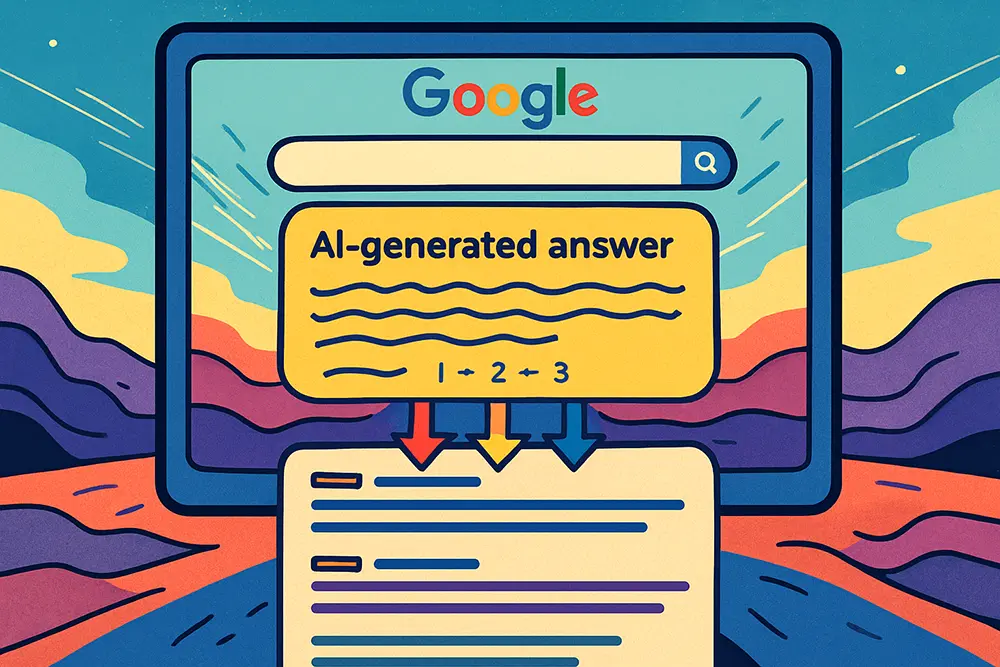
Because Google couldn’t ignore AI development, it built its own generative layer on top of search. SGE (Search Generative Experience) introduced an AI snapshot at the top of the SERP: a summary based on LLM output, with sources cited as references.
The implications for SEO:
- SERP fragmentation reached a new peak: The “blue links” shifted further down. Visibility now lived in citations and entity recognition.
- The citation economy became the new SEO model: You no longer need to rank in the top 3 — you need to achieve source status.
- New KPIs emerged: The focus shifted toward AI integration and snapshot citation rate.
5.3. The expansion to E-E-A-T: experience as a corrective to AI
In December 2022, Google added an extra “E” to E-A-T: Experience. Google gave no reason of its own — but the timing, weeks after ChatGPT launched, makes it tempting to read experience as the one signal generated content cannot supply.
- Experience required proof that the author or domain had actual, hands-on experience with the topic.
Why Experience plays such an important role:
- AI can simulate expertise, but cannot possess experience: That’s why Experience is the only “human” signal AI cannot replicate.
- Real examples = proof: Reviews, photos, cases, personal insights make content credible through authenticity.
- YMYL became even stricter: Health, money, law: AI must not beat demonstrable expertise.
SEO became more human as a result, not less.
5.3.1. Experience in action: why authenticity makes the difference
Experience is the only E-E-A-T signal that AI cannot simulate. An LLM can mimic expertise through training data, but it cannot tell the story of “the time something went wrong and how we fixed it.” Three constructed but recognisable examples of how that difference plays out in practice:
In technical B2B:
A page on cloud migration written by an architect with 40+ projects under their belt — including concrete obstacles (“On day 3, the legacy database turned out to be incompatible with the new API structure — here’s how we resolved it”) — consistently outranks generic “best practices” content from a content agency. The page includes anonymised screenshots of whiteboard sessions, a checklist of common mistakes from real projects, and the author is listed with their LinkedIn profile and certifications. The pattern this example illustrates: this type of page structurally gains ground on generic content — in rankings and in AI citations.
In healthcare:
A cardiologist writing about arrhythmias and referencing patterns from their own consultations (“In my practice, I regularly see patients confusing symptom X with Y”) carries higher authority than medical content without an author perspective. The addition of concrete (anonymised) case studies, results from their own treatments and references to peer-reviewed papers the author contributed to makes the difference between “information” and “expertise.”
In legal advice:
An employment lawyer who analyses a dismissal case they personally handled — with specific case law and lessons from the process — is more frequently cited in AI snapshots than general legal articles. The key: specific details only someone with hands-on experience can provide. “In this case, the court rejected the dismissal because…” is more powerful than “A court may reject a dismissal if…”
What these examples have in common:
- Concrete specificity: They contain details only obtainable through experience. Not general theory, but specific situations with concrete solutions.
- Visible author: The expert is identifiable: name, role, background, often with a photo and LinkedIn profile. Google can verify the author as a real person with relevant expertise.
- Evidence: Cases, data, photos, timelines, results. The more “proof of having done it,” the stronger the Experience signal.
- Schema.org markup: The author is marked up with Person schema, the organisation with Organization schema, expertise with knowsAbout properties. This makes Experience machine-readable.
The implementation steps:
- Identify your internal experts — not your marketers, but the people who do the work.
- Let them write or contribute substantially — interview experts and develop their stories into authentic content.
- Make their expertise visible — author pages with bio, LinkedIn, certifications.
- Add evidence — cases, photos, data, concrete figures from real projects.
- Structure it with schema.org — mark up the author, organisation, expertise and content type.
The core lesson:
Experience is the answer to AI’s democratisation of content. The only thing an LLM cannot replicate is having actually done it. And that’s precisely where Google will increasingly filter — and where users are becoming more consciously discerning.
5.4. SEO as data management: structured data, entities and the Knowledge Graph
In the AI era, SEO shifts from content creation to content anchoring. LLMs learn in entities, facts and relationships.
- Structured data is technical hygiene, not a ticket in: Google itself says no special markup is needed to appear in AI features. But consistent, machine-readable information about who you are and what you cover helps systems recognise you correctly — and recognition precedes everything.
- SEO now revolves around entity management: Entities are the building blocks of how machines store knowledge. For SEO, this means naming entities consistently, linking to reliable sources and applying schema.org correctly.
You’re no longer just feeding Google — you’re feeding every AI model that’s paying attention.
5.5. The future of SEO: from rankings to relationships
The essence of modern SEO: “If AI generates my answer, why would a user still click through to my site?”
The new differentiators are:
- Unique experience: Content that AI cannot replace (proprietary data, unique tools, real-world experiences).
- Direct trust: Strong brand and clear authorship = higher chance of being cited by AI.
- Niche depth: Content too specialised and recent for general LLMs.
- Interaction and tools: Your own calculators, configurators and datasets — assets a model does not have of its own.
SEO is evolving into a discipline of managing relationships between people, sites and models — not purely “ranking.”
5.6. The common thread: SEO always follows behaviour — not the algorithm
As every period in this article shows:
- In 1995, users wanted direct answers → webmasters built walkthroughs.
- In 2015, users wanted reliability → E-A-T emerged.
- In 2020, users wanted synthesised answers → generative AI exploded.
SEO doesn’t change because Google changes. SEO changes because people change. Technology follows that behaviour — and SEO follows the technology.
That’s why SEO is not dead. SEO has never been dead. It just keeps changing role: from findability → to quality → to authority → to experience → to data supplier.
VI. The synthesis: the mature SEO discipline and the road to 2030

Three decades of search behaviour, technology and trust brought together in one strategic framework.
After five major eras — from the early web to the age of generative AI — SEO has grown into a mature discipline.
No longer a checklist of technical optimisations, no longer a bag of tricks for clever webmasters, but a strategic domain where content, authority, experience and data quality converge. SEO is no longer a marketing tactic. SEO is how an organisation demonstrates its digital credibility in a world where machines and people search together.
This closing section synthesises 30 years of evolution and maps the road ahead.
6.1. The fear of irrelevance: why AI is not a threat but an evolution
Before synthesising the full evolution, we need to address one persistent concern: the fear that generative AI will make organisations irrelevant in the search landscape.
Since the rise of ChatGPT and Google’s SGE, three reactions have emerged that feed this fear — and all three miss the essence of what’s actually happening:
- The death of manipulation: Those clinging to old tactics watch their toolbox evaporate. Keyword stuffing no longer works, link farms have become toxic, thin content gets filtered out. What they’re experiencing isn’t the end of findability — it’s the end of manipulation. They’re confusing “my approach is outdated” with “the ability to be found is disappearing.”
- The myth of the zero-click apocalypse: Techno-pessimists predict a zero-click apocalypse: if AI answers directly, why would anyone click through? This reasoning misses three fundamental truths:
- Trust: For important decisions (financial, medical), people trust sources more than unverified AI summaries.
- Citations: Being cited by AI systems is the new form of visibility. Authority and brand recognition remain intact.
- Transaction: Transactional intent (buying, booking, reserving) requires a destination — though even that is shifting: AI assistants are starting to check out inside the conversation itself. All the more reason for your flow to be that destination.
- The expertise barrier: Organisations used to “organic = free” experience the increased complexity as a barrier. The truth is sharper: what once required a content writer and a technical checklist now demands internal expertise, demonstrable authority and long-term strategic investment. The bar hasn’t disappeared — it’s simply been raised.
The core lesson: the unchanging human need
What these reactions have in common: they look at the technology — not at the human need. And that need has remained constant since the very first moment someone opened a search engine: people want answers, solutions and information they can trust.
As long as that need exists, there will be a system that determines which sources provide that information. Once it was PageRank. Then E-A-T. Now it’s AI recognition and citation worthiness. The mechanism evolves radically — the human need does not.
AI doesn’t change the playing field. It refines the question: “Who has the best information?” to “Who is the most trustworthy source?” And that shift only becomes clear when you see the full evolution in perspective.
6.2. The evolution in one strategic timeline
Every shift in SEO has been a response to what users expected from the internet at that moment — and to Google’s need to minimise risk, abuse and noise.
Here is the SEO evolution summarised in one table:
| Era | Central focus | SEO discipline | Google's quality question |
|---|---|---|---|
| Pre-2000 | Findability | Registration, meta keywords, directories | "Does this content exist?" |
| 2000–2010 | Authority | PageRank, link building, technical SEO | "Is this content important?" |
| 2010–2015 | Quality | Panda/Penguin, UX, mobile | "Is this content good and usable?" |
| 2015–2020 | Trust | E-A-T, topical authority, intent | "Can we trust this source?" |
| 2020–Nu | Intent & data | Content entities, structured data, AI citation | "Is this the best source to feed our AI?" |
6.3. The definition of the mature SEO discipline
The table proves that SEO has never died — the entry criteria have simply risen exponentially.
Today, SEO is not: a way to optimise your website.
Today, SEO is: The strategic process of demonstrating verifiable expertise and authority (E-E-A-T), in an AI-processable structure, to fully satisfy the user’s search intent.
The modern discipline rests on four pillars:
- Strategic intent: Content must fully understand and satisfy the underlying question and the customer journey.
- Demonstrable authority: The credibility and verifiable experience of the author/organisation is the hardest entry requirement (E-E-A-T).
- Machine-processable architecture: Content must be structured (Schema.org, entities) in a way that allows Large Language Models to process and cite it directly.
- Superior user experience: The technical foundation and performance must be excellent to serve the user (and Googlebot) quickly and on mobile.
6.4. Organising for the future: the end of the SEO silo
Many businesses still organise SEO as an isolated “technical task.” The AI era demands a fundamental rethink of organisational structure. Countering the buffer zone around large domains requires making internal expertise visible.
SEO must not be a department — it must be a mental and operational synthesis.
| Old SEO thinking | New E-E-A-T / AI organisation |
|---|---|
| SEO is an IT task | SEO is a strategic asset owned by the C-suite and marketing. |
| Content is a copywriter's task | Content is an E-E-A-T task, managed by domain experts. |
| Structured data is a technical checklist | Structured data is a data science task: it feeds the AI. |
| Authority is link building | Authority is PR and brand building (earning citations). |
Businesses that survive in this era are those that free up their internal expertise (the engineer, the lawyer, the specialist) and make that expertise visible to both the human reader and the LLM.
6.5. The road to 2030: the niche and the citation economy
What does this evolution mean for the years ahead? The common thread remains the most reliable predictor: Google will always move closer to human intent and the human need for trust.
- The revaluation of the niche: AI search will get increasingly better at recognising superior, hyper-specialised niche experience. This creates an opportunity for small, highly competent players to outperform the mediocre content of large brands.
- Focus on intent coverage: The battle will shift even further toward fully owning a topic (Topical Authority) and adequately answering every possible question in the customer journey.
- SEO is no longer website optimisation: By 2030, SEO will primarily be about optimising your digital entity and data so that you are cited and processed by multiple AI models — no longer just by the traditional SERP.
And that shift requires a fundamentally different way of measuring.
6.6. The new metrics: measuring success in the citation economy
In the era of AI-generated answers, KPIs are shifting fundamentally. Traditional SEO dashboards — rankings, clicks, impressions — no longer tell the full story.
Here is the new measurement framework for the citation economy:
Layer 1: Traditional Visibility (Remains relevant, but relative)
These metrics haven’t disappeared, but their meaning is changing:
- Organic traffic: Declining for informational queries, stable for transactional intent. Segment your data: traffic to product pages remains important, traffic to “what is X” content becomes less relevant.
- Ranking positions: Still important, but always relative to SERP features. Position 3 with a featured snippet can be more valuable than position 1 without one.
- Click-through rate (CTR): An indicator of whether your snippet is compelling enough among AI snapshots. Declining CTR with stable impressions? AI is gaining ground.
Layer 2: SERP Presence (Growing in importance)
You’re no longer competing for one position, but for multiple visibility touchpoints:
- Featured snippet captures: How often do you appear at position 0? Track this per core topic.
- People Also Ask (PAA) presence: Are you part of the question cascade? This is a direct indicator that Google sees you as an authority within a topic.
- Knowledge panel ownership: Do you control your entity in Google’s Knowledge Graph? For brands and individuals: essential.
- Image pack and video carousel: Multimedia visibility in the SERP. Especially relevant for product, tutorial and how-to content.
Layer 3: AI Citation Metrics (The new frontier)
This is where it gets interesting — and where tooling is still rapidly developing:
- SGE citation tracking: Monitor how often you appear as a source in Google’s AI Overviews. This is your new “ranking.”
- ChatGPT and Perplexity citations: Referral traffic shows the clicks that come out of AI answers; how often you were cited — including without a click — only shows up in dedicated measurement.
- Brand mention volume: Track how often your brand is mentioned, even without a link. AI models train on these signals — unlinked mentions are growing in value.
- Entity consistency: Is your organisation named identically everywhere — on your site, your profiles and in external sources? Inconsistency is the fastest way to blur as an entity.
Layer 4: Authority and Depth (Proxy metrics)
These metrics are indirect indicators of citation worthiness:
- Domain authority development: In an AI world, established authorities are cited more (the buffer zone).
- Content depth score: Measure average word count, number of subtopics and internal link depth per pillar page. Deeper, better-structured content = higher chance of citation.
- Expert byline coverage: Percentage of your content with demonstrable author expertise (name + bio + LinkedIn + schema.org markup).
The new dashboard: a practical model
Build a monthly dashboard with these weightings (example):
| Category | Weight | Key metrics |
|---|---|---|
| Classic SEO | 25% | Top 10 rankings for core keywords, organic traffic (segmented) |
| SERP features | 30% | Featured snippets owned, PAA appearances, Knowledge Graph |
| AI & citations | 35% | SGE citations, brand mentions, referral from AI tools |
| Authority | 10% | Domain authority trend, expert byline %, structured data coverage |
The final irony: SEO is not dead
As this entire history shows: the advanced AI of today brings us back to the very first principle of SEO: provide unique, valuable information to the user.
SEO has never been dead. It just keeps changing role:
From findability → to quality → to authority → to experience → to data supplier.