I. The question nobody asked but everyone should have
Somewhere in 2023, something started shifting that most marketers didn’t notice straight away.
Not in their analytics. Not in their campaign results. But in the behaviour of people before they’d even typed a single search query.
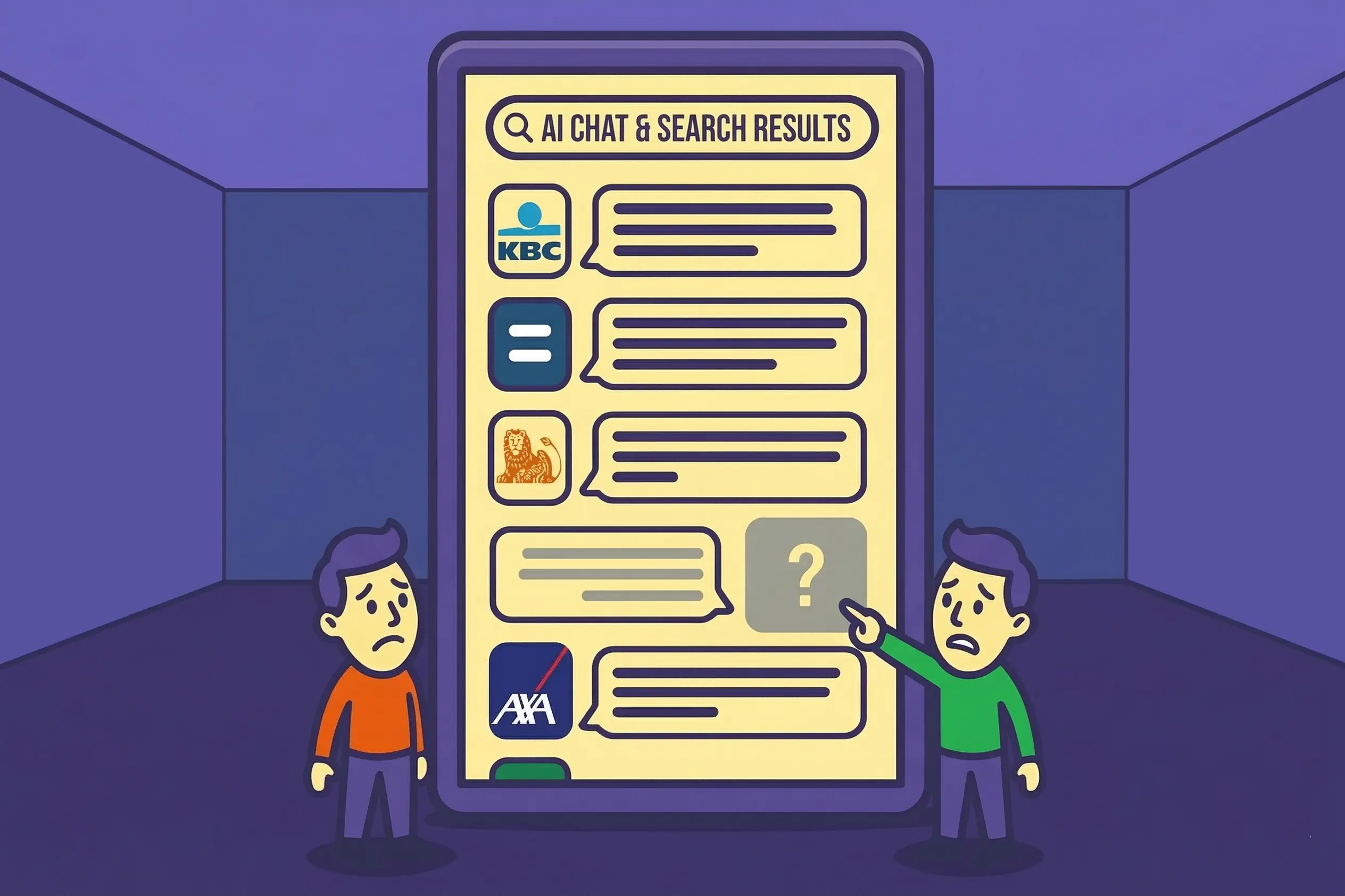
People started asking questions to AI. Not “best bank Belgium” in Google. But “which bank would you recommend for a mortgage?” to ChatGPT. Not “cheapest home insurance” in a search box. But “compare the home insurance policies of KBC, Belfius and BNP Paribas Fortis” to a language model that simply answered. Without sending them to ten websites. Without sponsored links. Without you as a brand having had the slightest chance to show up.
And that answer — the one the AI formulated, without your input, based on what has been written about you — began taking over the orientation phase of buying decisions.
I didn’t notice this as a consumer. I noticed it as someone responsible for the digital visibility of a large brand. One day I tested ChatGPT for our sector. Our brand was in there, but the question that stuck with me was: why? And what happens if that changes tomorrow without us seeing it?
That was the moment I realised: there’s a new metric that most dashboards aren’t measuring yet. And if you’re not measuring it, you’re losing ground invisibly — without knowing it.
That metric is called LLM Visibility.
II. What LLM Visibility is — and what it isn't
LLM Visibility is the degree to which a brand, product or service appears in the answers that AI language models generate in response to relevant questions.
Put simply: when someone asks an AI model about your product or sector, do you get mentioned?
It’s not a ranking. There’s no position 1 to 10. It’s a percentage: of all the relevant questions that can be asked about your domain, in what percentage of answers do you appear?
It’s also not an SEO metric. It’s not a social media metric. It’s a separate dimension — and the difference from what you measure today is more fundamental than it seems:
You can rank at position 1 in Google for a keyword and still have a weak presence in AI answers on that same topic. SEO rankings and LLM Visibility are driven by different mechanisms, and that gap widens as AI plays a bigger role in the orientation phase.
| SEO | LLM Visibility |
|---|---|
| Rankings in search results | Mentions in answers |
| Clicks to your website | Presence within the answer itself |
| Ten blue links | One generated answer |
| Page optimisation | Entity management |
Three things you do measure with LLM Visibility:
- Mention frequency — How often do you appear in answers to relevant questions?
- Position within the answer — Are you mentioned first or fifth? Are you recommended or merely referenced in passing?
- Tone of the mention — When you are mentioned, is the framing positive, neutral or critical?
III. Why this matters now
AI language models have existed longer than 2022. But the breakthrough of ChatGPT fundamentally changed how people interact with AI. Suddenly, ordinary people — not technicians or researchers — were using language models as a daily information channel.
The growth since then has been staggering. ChatGPT had more than 400 million weekly users at the start of 2025. Google’s AI Overviews appear in nearly half of all searches. Perplexity explicitly positions itself as a search engine replacement. Copilot is embedded in the Microsoft tools that millions of people use every day.
But it’s not just about numbers. It’s about behavioural change.
There’s a specific type of search query that is structurally shifting from Google to AI: the orientating, comparative question. “Which bank is best for a young starter?” “What are the pros and cons of a branch 21 insurance product?” In the past, you’d open ten tabs for that. Today, you ask an AI model and get one answer.
That answer determines which brands you go on to consider — and which you don’t.
And unlike Google, where you’re at least visible as a result someone can scroll past, in AI you’re completely absent if you’re not in the answer. There is no page two. And even though ads are now appearing in and around AI answers — the answer text itself is not for sale.
IV. How AI models determine what they say
Here’s a distinction that’s crucial but rarely explained clearly. There are two fundamentally different mechanisms — and the strategy differs per mechanism.
Parametric knowledge is what the model learned during training. Months or years ago, the model processed enormous volumes of text and stored patterns and facts within it. This knowledge is baked in. If you’ve been prominently present in quality online content for years, the model is more likely to know you and mention you.
The downside: you can’t change this quickly. Until a model is retrained — which can take months to years — your current presence is frozen in what the model knows. This is a long-term game.
Retrieval-Augmented Generation (RAG) is fundamentally different. Models like Perplexity — but also ChatGPT with search enabled and Gemini — actively consult external sources in real time for certain queries. They retrieve current web pages and incorporate them into their answer.
This is the mechanism where you can act now. Good structure, fast load times, clear answers to specific questions, consistent structured data: that can raise your chances of being picked up.
A factor many marketers underestimate: Reddit, forums and user discussions. Several major AI companies have signed agreements with content platforms to access user-generated content for training and retrieval. What users write about you, not just what you communicate, counts in what AI says about you. Community management is therefore no longer a nice-to-have. It’s a component of your AI visibility strategy.
V. Visibility, Citation and Sentiment — three signals, one story
When you start measuring LLM Visibility, you encounter three signals that each tell you something different. Visibility — how often are you mentioned? Citation rate — how often does the model actively reference your domain as a source? Sentiment — when you are mentioned, is the tone positive, neutral or negative? The crucial nuance lies in the combination:
| High Visibility | Low Visibility | |
|---|---|---|
| High Sentiment | ✅ Ideal: present and positive | 💎 Hidden Gem: quality is there, reach is missing |
| Low Sentiment | ⚠️ The Notorious Brand: well-known but not favoured | 🚨 Double problem |
A brand in the “Hidden Gem” position is rarely mentioned but always positively. That sounds good but is a strategic weakness: you can’t rely on positive sentiment when you’re barely in the answer at all.
A brand with high visibility and average sentiment faces the risk of presence: the more often you’re mentioned, the more variation in tone. That’s not a reason to avoid visibility. It’s a reason to actively work on sentiment.
VI. Why you can't see this in your dashboard today
Google Search Console shows you impressions, clicks and positions. Google Analytics shows you traffic and conversions. Semrush and Ahrefs show you rankings and backlinks. For a long time, none of these tools told you what an AI model says about you when someone asks a question. That is starting to shift: Search Console gained separate reporting for generative AI in June 2026, and the major SEO suites are building AI visibility modules. But that reporting shows impressions and clicks from AI answers — not what is being said about you, not whether you are recommended. The fundamental measurement is still missing.
That’s not a minor gap. It’s a fundamental measurement that’s missing.
Suppose your AI visibility drops by 20% over six months. Your Google rankings are stable. Your traffic is stable. You won’t see this in your standard dashboards. But in the meantime, you’re losing the orientation phase to competitors who score better in AI answers. Months later you notice a dip in conversions or market share and you can’t figure out where it came from.
This is not a hypothetical scenario.
VII. Why you're missing from AI answers
When brands measure their LLM Visibility for the first time, four reasons come up again and again:
1. No clear entity
If your brand isn’t clearly defined in external knowledge sources — Wikipedia, the Knowledge Graph, structured data on your own site — the model doesn’t really “know” who you are. You exist as a name, but not as an entity with context, products and expertise.
2. Too product-focused, not enough explanatory content
AI models cite sources that answer questions. A product page that says “Discover our competitive savings account” doesn’t answer a question. A page that explains “How does the withholding tax exemption work for Belgian savings accounts?” does. The distinction sounds small but has a big effect.
3. Too few external citations
What others write about you counts more than what you say about yourself. Press articles, comparison sites, trade blogs, forums: together they build the reputation that AI models use as a source. If that external presence is thin, your AI visibility is too.
4. Content fragmentation
A brand that writes a little about everything across ten domains scores worse than a brand that demonstrates deep expertise across five. AI models recognise and reward topical authority: the perception that you are the go-to source for a specific topic.
VIII. How to start measuring
Start small: focus on your five most strategic products or services. For each product, formulate three types of questions:
Non-branded — no brand name required, you’re simply relevant. “What’s a good savings account for a student in Belgium?”
Branded comparison — multiple players are asked about. “Compare the car insurance from KBC and Belfius.”
Situational — from a specific user situation. “I’m buying my first home, how do I choose the right bank?”
Run the prompts in ChatGPT, Gemini, Claude and Perplexity. Manual testing is a good starting point for a baseline measurement. For weekly monitoring you’ll need tooling: Peec AI, Profound or the Semrush AI Visibility Toolkit are the main options today.
Quick win: start with niche-specific content. AI models cite sources that cover one specific topic in real depth. A blog post “How do I calculate the residual value of a hybrid car when terminating a leasing agreement?” often scores better in AI answers than a general page about car loans. Not because it’s more popular, but because it answers a specific question better than any other source.
IX. Being honest about the limitations
Measuring LLM Visibility is not an exact science — and you need to know that before you start steering on it.
AI answers are not stable. The same question put to the same model at two different moments can produce two different answers. Good monitoring tools compensate for this by running prompts multiple times and averaging the results, but variability is inherent to how language models work.
Models differ significantly. What ChatGPT says about you is not what Gemini says. Perplexity retrieves live sources and responds faster to recent content. Claude has different training data. Your visibility in one model says little about your visibility in others.
Training data contains bias. If your sector is historically overrepresented in English-language content, a Dutch-language brand may be structurally disadvantaged — even for Dutch-language queries. That’s not a reason not to measure. It’s a reason to read the data with context.
X. An honest conclusion
LLM Visibility is not hype. It’s also not a silver bullet.
It’s a new measurement dimension that closes a blind spot in how we think about digital presence. And that blind spot grows larger as AI plays a bigger role in how people search for information and make decisions.
The brands taking this seriously now — measuring, analysing and adjusting — are building a lead that will be hard to close in two years’ time.
The question is not whether LLM Visibility matters.
The question is when you start measuring.