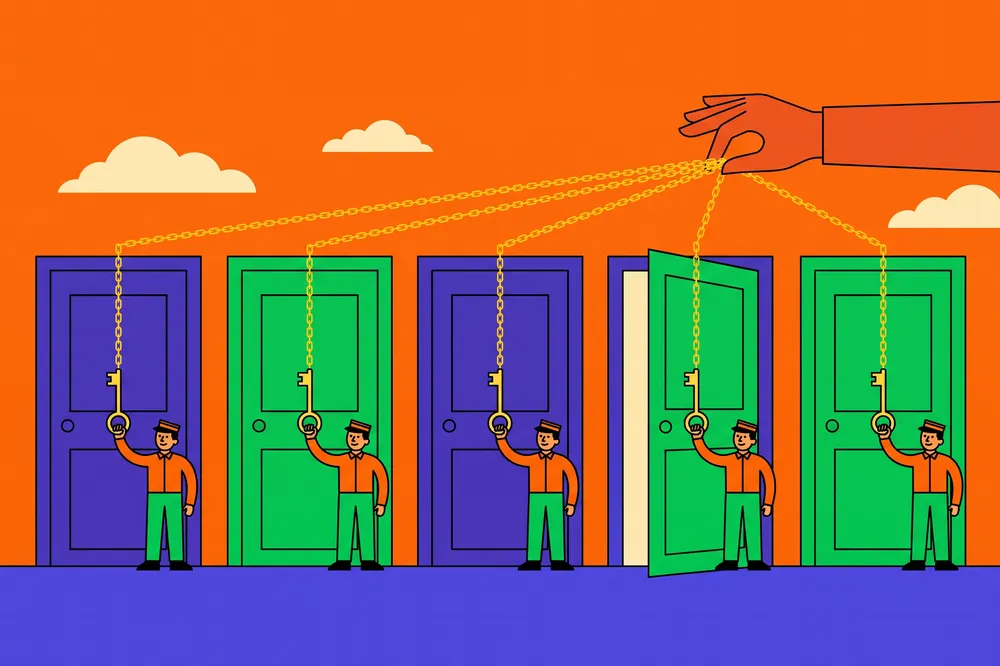
A layer of power has formed around AI recommendations that nobody asked for. The platforms that landed in it didn't know at first what they were holding. They know now. What nobody knows is how long they get to keep it.
I. The non-answer
A while ago I put a question to a senior figure at Trustpilot. This influence you now have over what AI systems recommend — did you see it coming, or did it land in your lap?
He couldn't answer. Not because he didn't see the influence. He saw it perfectly well. But whether it was strategy or luck, he couldn't or wouldn't say.
At the time, that non-answer struck me as the whole story of a new market: when even the winner has no answer to whether he won by insight or by accident, you are looking at something that has only just been born. The answer has since arrived. His sector now sells that influence as a product. More on that shortly. First, what exactly has shifted.
II. Where the answer comes from
An AI answer doesn't come out of nowhere, but it doesn't come purely from what the system retrieves either. Ask Perplexity, Copilot or ChatGPT for the best provider in a category and three things happen in sequence. The model already has a notion of which names belong in that category — the prior knowledge I wrote about earlier. It decides which sources to search and shows a selection of them. And out of that material it builds an answer, in which some candidates survive and others quietly disappear.
The sources sit in the middle of that chain. Review platforms. Comparison sites. A few media titles. Some institutional names. Forums. And, more often than a year ago, the brands' own pages.
None of those sources ever set out to become the referee of AI recommendations. They were building traffic, leads, an audience. Then one day it turned out their judgement no longer reached only the visitor who looked them up, but also the system that never sends that visitor on.
They became gatekeepers without ever applying for the job. But it is a gatekeeper with a boss. The model decides what it retrieves and what it keeps — and it can decide differently tomorrow.
III. From traffic to judgement
The old value of such a platform was measurable and simple. How many people come by, how many click through, how many leads do we deliver. A dashboard could handle it.
The new value is broader and far harder to see. When an AI system recommends a brand because it stands strong on that platform, the judgement is adopted by someone who never visits the platform at all. Pew Research measured last year that when a Google result carried an AI summary, users clicked a source inside that summary in one per cent of visits. The influence travels; the visit stays home.
The treacherous part is the measurement. A comparison site that draws fewer visitors but appears in more answers sees its judgement travel further than ever — and looks weaker on paper. That is exactly the kind of shift no classic dashboard picks up, because it counts the wrong thing.
For anyone managing a brand the inversion is different, but just as sharp. When someone asks "which provider would you recommend?", your story is assembled from pieces you only partly wrote yourself: your own pages, what comparison sites say about you, what customers wrote, what a journalist once noted, what lingered on a forum. Which of those pieces weighs most varies by channel, by market and by the kind of question. Your own site matters more in that mix than many assumed a year ago — one measurement firm saw the share of product pages among the sources ChatGPT shows nearly double in four months — but it is one voice among many, and most of the others are not yours to steer.
IV. How concentrated, and how fragile
This isn't theory. In the spring we measured the Belgian energy market twice, a few weeks apart, across seven AI channels and over two thousand answers per wave. We looked not only at which brands were named, but at which sources the systems showed alongside. A snapshot of one sector, in one country — but an instructive one. For those keeping score: two waves, early and late May 2026, 4,225 deduplicated answers in total across seven AI channels; every percentage is a share within its own wave.
The sources concentrated. In the second wave, five domains together accounted for more than a quarter of all sources shown — more than in the first. A quarter of all citations about an entire sector, held by five sites — and not one of them was an energy supplier.
The brands themselves barely featured. For one of the suppliers measured, roughly one in eighty sources shown came from the brand itself. That brand's core argument — the point on which it differs from the rest — appeared in fewer than four per cent of answers. Not because it is untrue. That suggests the sources the systems showed didn't tell it — and what the source doesn't carry, the answer can't repeat.
And the layer shifted while we watched. Reddit's share of the sources shown was nearly three times larger in the second wave than in the first. At the time I read that as an advance. Three months later several measurement firms reported the reverse: in the second week of August, Reddit's share of the sources ChatGPT shows fell from nearly four per cent to half a per cent — a drop the firms themselves still call provisional, and one that did not occur to the same degree in Google's AI products. Whether ChatGPT also consults Reddit less, nobody can see from the outside. What we can see: a source that tripled in May was, by August, almost out of the picture in one channel.
Our data shows a concentration, and the months that followed show how temporary it is. Why a system picks up a source or drops it, we cannot establish; we measure the shop window. But the shop window is enough to see who is standing in it — and how quickly the display changes.
V. From accident to product
Return to that non-answer. It is dated, and that is what makes it interesting.
The review platform from my anecdote reported a fourfold profit this spring and was labelled an "AI winner" in the business press. It now sells its profiles explicitly as a way to appear in AI answers, with its own "AI discovery" features, and commissioned an agency to analyse more than eight hundred thousand AI answers to back that story up. In that study, one in seven citations came from review and trust sites, rising to nearly one in four for questions close to a decision. The rest of the sector — software comparison sites, directories, PR tools — is building its commercial pitch around the same insight.
So the accidental gatekeepers have woken up. What was still a hunch in the spring is now a price list. That doesn't make the question smaller for brands, it makes it different: not "do they know yet?" but "what does it cost once they know, and what is it worth?"
Because the position they are selling is not one they own. They hold it on loan from a system that adjusts its choice of sources without notice — see Reddit. A gatekeeper who got his key from the model can hand it back to the model. Anyone buying visibility on such a platform today is buying something the platform itself cannot guarantee.
VI. What the source doesn't decide
There is one more reason not to make the gatekeepers bigger than they are. Being retrieved is not the same as winning.
A source can be cited while the brand behind it appears nowhere in the answer — in our own measurements we regularly see citation and mention drift apart, which is precisely why we report them separately. It can also happen the other way round: a brand is named without a single source next to it. And it can be galling. This spring an American SEO researcher had Google's AI Overviews answer a hundred "best software in this category" questions. In a clear majority of the cases where Google used a software company's own "best tools" listicle as a source, it recommended a competitor and left the author out.
The source supplied the material. The model wrote the verdict. That is the third link from section II, and it is the link over which the gatekeepers have the least say.
VII. Three questions for those on the outside
Most readers of this piece don't run a review platform. They work for a brand, or for the agency that supports one. For them it is the same chain, seen from the other side.
Who tells your story? Not in general, but concretely: which handful of domains shows up when someone asks an AI system a question in your category — and does that list differ between the orientation question and the question just before the decision? It is shorter than you think and more surprising than you'd hope. And it is a different list per channel.
What do they tell — and what does the model take from it? A source can name you without naming what sets you apart. In the energy data we saw brands that were present in the answers and yet remained interchangeable, because the argument they stand for was nowhere to be found in the retrieved sources. Being present, being recognisable and being recommended are three different things, and you want to measure all three separately.
And which of those sources can you influence? Some, not at all. Others — through your customers, your communication, what you publish and get cited, and increasingly through your own pages — more than you'd suspect. The source layer is not a weather report. It is a map, and on a map you can plot a route. You just have to redraw it more often than you'd like.
VIII. What the market doesn't know yet
A new layer of power has formed around AI recommendations, and it was not distributed according to who wanted it most. It was distributed according to which sources the systems started retrieving. Some of those sources have since understood that and are selling it. Brands are optimising themselves silly to be present on them. And above it all sits a model that brings its own shortlist, revises its choice of sources without a memo, and has the last word on who makes the answer.
The market now knows what it is holding. What it doesn't know is for how long.
The model makes the shortlist. The sources make it defensible. And neither of them has to put you on it.