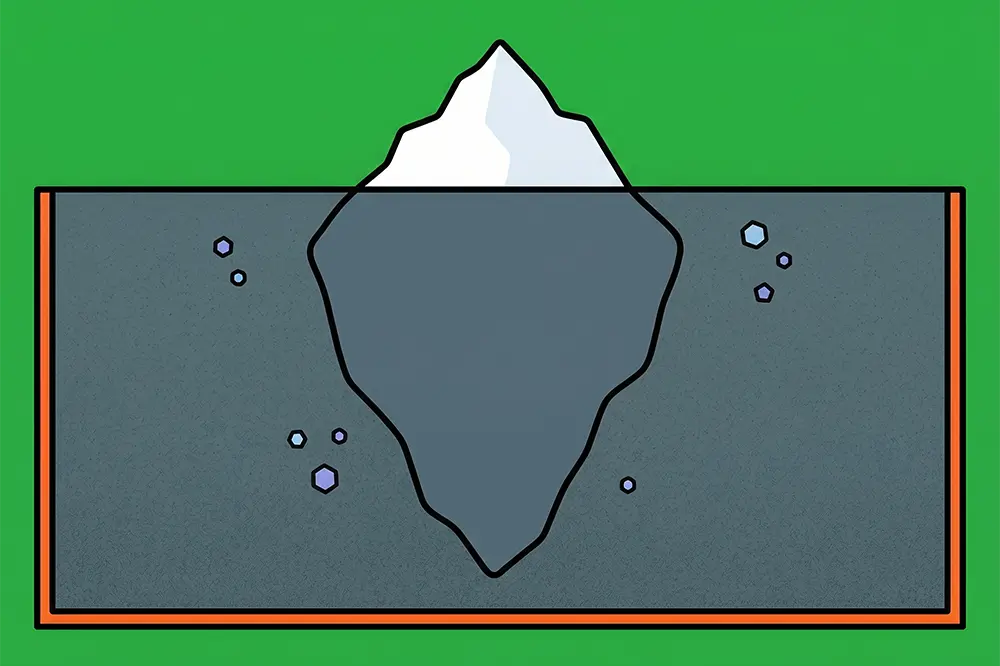
I. Your metrics still add up — but they're measuring the wrong thing
Your campaigns are running. CTR looks healthy. ROAS holds up. Cost per acquisition is moving in the right direction.
And yet something feels off. You’re measuring with precision — but you’re no longer sure what you’re measuring.
Paid media isn’t broken. It still works. But it’s measuring something different than it used to. And it’s reaching someone at a different point in their decision process than before.
Because there’s a moment your dashboard doesn’t see. A moment that happens before someone searches, before they click, before they ever encounter your ad. The moment they ask an AI model what to do — and the model answers. No ad. No click. No session data.
That’s where the shortlist forms. You were on it, or you weren’t.
What comes after — the searching, the comparing, the clicking — is the confirmation phase. Your ad is reaching someone who already knows what they want. And an ad that confirms is cheaper to produce than an ad that has to convince. But only if your brand made it onto the shortlist in the first place.
II. Zero-click isn't new — but AI makes it permanent
Zero-click search has been around for years. Featured snippets, knowledge panels, direct answers at the top of Google — the idea that a user gets their answer without clicking through isn’t new.
What AI changes is the scale and the depth. A featured snippet gives you a definition. An AI answer gives you a recommendation, a comparison, a step-by-step plan, a shortlist. The user has no reason left to click through.
Watch your own behaviour. When Google shows you an AI answer, how often do you still click through?
For paid media this means: the traffic you’re buying is more expensive per decision than it looks. Because part of the decision is made before the traffic even starts moving. That part is growing. And it’s invisible in your attribution model.
III. The attribution gap nobody reports on
Imagine this: someone asks ChatGPT which bank they should choose. The model lists your brand as the first option. A week later they see your display ad, click through, and request a quote.
In your dashboard: a conversion via display. ROAS calculated. Campaign optimised based on that data.
What your dashboard doesn’t show: the AI interaction that actually made the decision. The display ad confirmed rather than convinced. But in your attribution, display gets full conversion credit for a decision it didn’t make — its incremental contribution is smaller than your dashboard shows, and its true incremental cost per acquisition therefore likely higher.
The reverse is just as common. The model doesn’t mention your brand, or recommends a competitor. A week later that user sees your ad and clicks through anyway — but they already have a preference. Your conversion rate drops. Your cost per acquisition rises. And you’re tuning your bidding strategy while the real problem sits somewhere else entirely.
The fundamental difference with SEO and SEA: those always had a direct feedback loop. In AI there is no bid button. Steering is possible — through content, structure and the sources models consult — but it works more slowly and indirectly than a campaign setting.
That’s the attribution gap. Paid media managers optimise on the data they have. But the data only starts running from the click onward. You’re optimising the last mile. The decision was made earlier.
And the deceptive part: the numbers still look fine. Budgets get misallocated without anyone catching it. Success is measured correctly — but at the wrong moment.
IV. Paid and AI visibility aren't competing
This isn’t an argument for replacing paid media with AI visibility. That’s a false choice.
Paid media stays essential for what it does well: fast reach, activating new audiences, pushing seasonal offers, running price promotions. None of that changes.
What changes is the role paid plays in the bigger picture. A user who first encounters your brand through an AI answer and then sees your ad experiences that ad differently. It confirms. It activates. The threshold likely sits lower and conversion higher — proving it takes AI visibility laid alongside connected conversion data.
The other way round, paid can also feed AI visibility — indirectly: campaigns generate awareness and search demand, and brands that get written about more become better represented in the sources models consult. Buying media does not directly raise your organic selection. The two can reinforce each other. But only if you manage them as one strategy.
V. What you can actually measure today
The good news: AI visibility is measurable. Not through your existing dashboards — but through an approach that runs alongside your paid monitoring.
The basics: a set of open consumer questions — not branded ones — that you systematically run through multiple models. ChatGPT, Gemini, Perplexity. And you track not just whether your brand appears, but how.
Because that’s exactly the problem with most AI monitoring today: it measures presence and calls that visibility. But being present and being recommended are not the same thing.
Does your brand appear spontaneously on open questions? That’s your starting point. But a brand mentioned as an additional option, after the actual recommendation has been given, is technically present. It’s still losing the decision.
And when you do appear, how do you appear? First recommendation or fifth option? With confident language or with hedges? “Brand X is a strong choice” and “Brand X is also an option” are both mentions. Commercially, they’re worlds apart.
And then there’s the question that sits closest to what paid media is actually trying to achieve: how often do you appear first and with conviction? That moment — where presence and preference align — is missing from virtually every AI dashboard out there.
Together, these observations tell you something your paid data can’t: what’s happening before the click — and whether you’re winning it or losing it.
VI. What you can do without reinventing the wheel
Content that answers, not slogans that sell. AI models don’t learn from campaign language. Every FAQ page, every product explanation, every article that answers a real consumer question is potential material. Content as knowledge source.
Your landing page deserves a new role. The visitor arriving via AI is past the “what is this?” phase. They’re in the “prove it” phase. Your homepage is no longer your pitch. It’s your evidence.
Structured data. Schema.org markup helps models interpret your content.
Presence in sources models trust. Independent, neutral sources: comparison sites, consumer organizations, journalistic coverage.
Define a target AI profile. Which products should be associated with your brand? Which strengths? Which context?
VII. The question to put to your team
Next time you’re in a paid performance review, ask one question that probably nobody can answer:
“What are AI models saying about our brand when someone asks about our product category — without naming us?”
If nobody knows, you have a blind spot in your marketing strategy. No reason to panic — but every reason to do something about it.
Because the user who lands on a competitor through AI, and then sees your ad, has already decided. You’re paying for an impression with someone whose shortlist is already set — and you’re not on it.
That’s not a paid media problem. It’s a visibility problem that paid media just makes visible in the numbers.
AI visibility is not an alternative to paid. It’s what makes paid effective.